Saturday, March 29, 2014

A Look at the Numbers

It's an inescapable fact that education is currently driven by data: numbers, scores, graphs, and charts are our main (only?) means of determining whether the ways and means by which our children are educated have value. Progress is key, and it is measured by an endless trail of formal assessments--buttons clicked, letters circled, and bubbles filled in. I see this again and again in the schools where I am working, from the time students enter kindergarten to the time they graduate high school. I think many people are interested in the alternative methods of education that I blog about (Waldorf, Reggio Emilia, etc), but are hesitant to embrace them because of their lack of emphasis on data. "Without the information gathered through assessment programs, how will we know that students are hitting their benchmarks?" they wonder. It's a very different frame of mind than the one I possess, but it is undeniably here to stay for the time being. And so I wonder: how do we convince those that are so very focused on assessment data that alternative models of education are effective?


Well, we can attempt to play the game and compare the numbers.

In October 2012, Larrison, Daily, and VanVooren published a study in Current Issues in Education titled "Twenty Years and Counting: A Look at Waldorf in the Public Sector Using Online Sources." This study aims to examine the effectiveness of Waldorf Education in public charter schools by comparing standardized test score data and parent comments with those from non-Waldorf public schools that teach using traditional educational methods. Waldorf charter schools (sometimes called "Waldorf-Methods" or "Waldorf-Inspired" charters) are one of the fastest-growing options for alternative education in the country. Waldorf-methods charter schools combine a Waldorf curriculum and environment with the standards of a public school. Their adherence to public school standards necessitates some adjustments, such as beginning formal reading instruction in kindergarten instead of in first grade, but the values and ethos of a Waldorf school remain. Literacy is imaginative and hands-on, stemming from poems, songs and verses, and stories are retold by students through dramatic play. The curriculum is arts-infused, and kindergartners learn their letters through pictures that gradually morph into the familiar symbols we know. Learning comes at a slow and steady pace, with students allowed to develop and flourish at a more individual rate than the hurried one that is pushed in many public school classrooms. Because Waldorf charters are funded publicly, though, students are required to take yearly standardized tests, just as they would in a traditional public school. Larrison et al use this scoring data to establish the efficacy of the Waldorf method as compared to traditional educational methods in their study.


The table above compares standardized testing scores between public Waldorf charters and district averages in the year 2008. In both reading and math, notice the trend that Waldorf students begin with lower test scores in the primary grades, but by eighth grade their scores have significantly surpassed students in schools with traditional methods.


The second set of graphs compares students in public Waldorf charters in California with students in non-Waldorf schools in the same or neighboring districts that share similar demographics. Again, the trend shows Waldorf students with lower test scores in earlier grades, but a jump to surpass their non-Waldorf peers by the later grades.

What does this study suggest? Larrison et al write, "The question this data presents is whether there
is any value at all of using test scores in determining the quality of education particularly in the early grades...Given that early test scores appear not to hold any predictive value for a student’s ultimate academic success, at least for Waldorf, and there is no reason to suspect these children are biologically unique, it is important that we reconsider the utility of early grade testing at all." They conclude that "[the] lack of correspondence of test scores to qualitative measures of schools performance should be a considerable concern for policy makers who support testing in the early grades. If we are to gauge schools based on test scores then these tests should at least be reliable measures of student outcomes in later grades. If not, then we must question the expense, time and stress of testing at all. Until reliable measures of school quality are available, the impact of testing should be minimized, especially in the lower grades."

In addition to bringing into question the effectiveness and rationale for standardized testing in the early grades, this study shows that a slower, more developmentally-appropriate approach to reading instruction in early childhood and the primary grades does not mean poor proficiency in the later grades. In fact, it shows the opposite: that the Waldorf approach to early literacy builds a foundation for future proficiency.

With this information in hand, perhaps we can move forward with providing young children with holistic, child-centered education in public schools.

Wednesday, March 5, 2014

The Waldorf Experience: A Remarkable Education


Here we have another video about Waldorf education--this time from the Waldorf School of Bend, Oregon. I feel that this is a fairly accurate look at life in a private Waldorf school.

Sunday, March 2, 2014

The Third Teacher


     Last week I wrote an overview of the Reggio Emilia approach and how it relates to literacy in early childhood and the primary grades. I touched briefly on Reggio's idea of the learning environment, but I think it's so interesting and inspiring that I'm going to devote this week's entry solely to the Reggio classroom.

     The Reggio Emilia approach refers to environment as the "third teacher," after parents and teachers. This means that the learning environment should be constructed in such a way that it is not just a container in which learning occurs, but is a space that inspires and facilitates learning in all students. Teresa Strong-Wilson and Julia Ellis collaborated on Children and Place: Reggio Emilia's Environment as Third Teacher (Theory Into Practice, 2007), a wonderfully written article that explores the concept and effectiveness of the Reggio learning environment.

     Strong-Wilson and Ellis identify eight principles that guide the construction of a Reggio Emilia classroom: aesthetics, transparency, active learning, flexibility, collaboration, reciprocity, bringing the outdoors in, and relationships. The Reggio Emilia approach looks at the learning environment from the child's perspective. Strong-Wilson and Ellis contrast the environments of a typical kindergarten classroom (visually busy, and full of commercially-produced, stereotyped images that may "silence the actual lived experiences of those individuals learning together") with an environment that inspires inquiry by utilizing natural light:
"Because it was located where the undergrowth was thickest, the classroom was often enveloped in a greenish light. Topics rich in local anecdote and story, like the sasquatch, could come alive. The filtered greenish light also reminded her of her "deep down" image of the child and those "secret spaces of childhood" where she used to play hide-and-seek with other children in the neighborhood."
      Reggio Emilia encourages teachers to look closely at their classrooms to envision ways that it could "speak" to the children and invite investigation and inquiry. Examples provided by Strong-Wilson and Ellis include placing small mirrors around the classroom, positioning easels in naturally lit areas, and introducing provocations--carefully selected items in the environment that may spark discussion and imagination, such as a pencil and paper in the block corner or a pizza box in the kitchen center. Other strategies for enlivening the learning environment include introducing realistic objects for play (real pasta in the play kitchen) and storing materials in transparent containers so that children are inspired to sort, organize, and recognize patterns of color and texture. Such changes, assert the authors, "animate the environment" for children, foster care for their surroundings, and encourage them to think inventively about materials.

     Following the eight principles identified in the article, Reggio Emilia classrooms have many common elements, including flexible, open arrangements that promote social interaction, neutral spaces with limited visual distractions, use of natural and authentic materials (baskets made of wicker instead of plastic), natural light, plants, and other "outdoor" elements, easy access to materials, and documentary displays of student work. Have a look at some truly inspiring Reggio Emilia classrooms:


     I can hear you saying, "Wow! Those are really amazing spaces. If only we could all work in a dedicated Reggio environment with custom-built furniture!" But don't dismay. For those of us who work in traditional classrooms but would like to integrate Reggio methods, there are plenty of resources out there to make a space more Reggio-friendly. One blog I especially like is The Third Teacher, an educator from Canada who works to integrate Reggio Emilia methods in her classrooms. In one of her posts, she gets some feedback from an experienced Reggio educator who makes the following suggestions:

  • move the group carpet out of the corner to the center of the room. This created a welcome focus and allowed for centers to branch of from the carpet and make use of the walls.
  • hang all the poems written on chart paper in one low and accessible place (the side of the filing cabinet). The poems were previously spread out in all areas of the classroom and added to the visual distraction. The children actually used them more by reading them and lifting them like a hanging book for reference.
  • remove the alphabetized word wall off the display boards and replace with a usable clear pocket chart. The children then found the word they needed and could take the word (on card stock) to any centre in the room, then return it.
  • cover busy patterns or unappealing surfaces with felt – to soften the dividers used for a reading area.
  • add a sheer curtain over a reading area to define the space and filter the light from the window. This change enhanced the reading center and made it more inviting to the children.
  • remove a shelf that blocked a view of the carpet area when entering the classroom to the side of the room as a divider between two learning centers.
  • remove the yellow and red bins.


You can see the difference before and after makes in this space!


Friday, February 28, 2014

Waldorf Reading

Here is a brief video that talks about some of the literacy strategies common in the Waldorf curriculum. I recognize quite a few of them as strategies we have discussed in various courses this year. Enjoy!


A note of interest: This video references the Waldorf curriculum's focus on Saints and Legends in second grade. Waldorf schools are not affiliated with any particular religion, but they do place emphasis on reverence of the "spirit" in the world around us--however that may appear to individual children. That being said, because the Waldorf movement came out of early 20th century Germany, many cultural traditions from that time and place are still observed in Waldorf schools, such as Saint Nicholas Day and Martinmas, and these traditions are overwhelmingly Christian in origin. Most Waldorf schools work diligently to ensure that traditions from other cultures are observed as well.

Sunday, February 23, 2014

The Hundred Languages of Children

 As you know, I am a self-professed Waldorf fanatic. I love most everything about Waldorf Education: the aesthetic, the warmth, the slow pace, the integration of art, music, and movement, the focus on rhythm, the respect for nature...I'll stop myself there, but I could wax poetic about Waldorf for many hours. There is one place that I have found Waldorf to be lacking, though: curriculum. Waldorf follows a very structured, prescribed curriculum through the grades. The content is based on Rudolf Steiner's philosophy of child development, and while I do think that some children live a path parallel to the Waldorf curriculum, many do not. Not all children grow or develop at the same pace, and not all children in seventh grade will be interested in the voyages of explorers (even if those children are embarking on the great voyage of adolescence).

Better and more inspiring in my eyes is the flexible, inquiry-based approach to curriculum found in Reggio Emilia schools. I find myself drawn back again and again to the amazing projects completed by Reggio students, and I decided to read more on the topic for this week's blog post. Jean Anne Clyde, a professor of education at University of Louisville, partnered with a group of elementary and early childhood educators to write the article, Teachers and Children Inquire into Reggio Emilia (published in Language Arts and accessible here). Clyde et al identify five distinctive characteristics of Reggio Emilia education:


          1. Children as Protagonists of Their Own Learning
              Howard Gardner describes Reggio's vision of children as "active, engaged, exploring young
              spirits capable of remaining with questions and themes for many weeks, able to work
              alongside peers and adults, welcoming the opportunity to express themselves in many
              languages, to create new ones, and to apprehend and enter into those modes of expression
              that are fashioned by their age mates."


          2. The Hundred Languages of Children
              This phrase, seemingly synonymous with Reggio, comes from a poem written by its
              founder, Loris Malaguzzi. Malaguzzi describes children as possessing a hundred different
              means to express their ideas and questions. In our literary context, I think we may rephrase
              this as children having "a hundred literacies." Reggio students are encouraged to use a
              multitude of media to describe their thinking, including (but definitely not limited to)
              writing, drawing, photography, sculpting, and acting. Aligning with Gardner's theory of
              multiple intelligences, different students will prefer different means of communicating. Part
              of the Reggio teacher's duty is ensuring that students have easy access to the materials they
              need, and the classroom becomes an atelier (studio).


          3. Inquiry-Based, Long-Term Projects as Vehicles for Learning
              As briefly explained above, Reggio Emilia does not operate on a curriculum, but allows
              students to develop large, long-term projects based on their inquiry. Usually an inquiry topic
              is followed by a whole class, and comes from student questions, often after observing a
              spontaneous event, like a milkweed pod bursting into seed. The Reggio teacher helps guide
              student inquiry through open-ended questions, but students take the reigns for how the
              project progresses. Clyde et al write that "investigations result in real-life problem solving
              among peers, and numerous opportunities for creative thinking and exploration."


          4. Documentation as Communication: "Making Learning Visible"
              One of the most time- and work-intensive responsibilities for a Reggio teacher is
              documenting the process of student learning. As the students go about investigating and
              exploring, the teacher collects physical artifacts of their learning (drawings, writing, etc),
              and documents non-physical work through photographs, videos, and audio transcripts. All
              of this information is then compiled into documentation panels, poster displays that work as
              a timeline of student learning and documentation of the project's evolution. Documentation
              panels can be viewed by administration, other teachers and students, parents, and--most
              importantly--the students themselves, who often form new questions and ideas when
              reviewing their previous work.


          5. Teachers as Researchers and Collaborators
              Reggio teachers are both guides and co-learners. They keep up with student questions and
              ideas, and work to anticipate possible paths that projects could take. They work as
              mediators, helping children to ask meaningful questions and develop goals for their
              learning. They plan experiences that may trigger student inquiry, and they collaborate with
              other teachers to build deeper understanding of students as learners and teachers.

(please note: If I were to make this list, I would also include a sixth characteristic: The Classroom as the Third Teacher. Reggio Emilia places great emphasis on the need for aesthetically pleasing, flexible spaces that allow students to freely explore their inquiry projects and enhance their ability to learn.)

     Much like the situated literacy project The Donut House, Reggio Emilia projects treat literacy as a tool for investigation--a means to getting to the end, which is understanding and communication. Clyde et al describe an investigation by a first grade class into the mystery of an empty pond on the school grounds: "[The students] learned to read informational texts, use the index and table of contents, present information using various modes, and assert hypotheses. Their use of diagrams, labels, and drama to support their hypotheses was an efficient and effective way to apply principles of summarizing, analyzing, and accommodating information." For the students in a Reggio Emilia classroom, writing, math, and art are not subjects to be studied, but just a few of the hundred languages that students utilize when exploring their world.

The more I learn about the Reggio Emilia approach to education, the more inspired I become. I still have many questions to answer: What is the place of more traditional literacy instruction in Reggio? What does Reggio look like for older children? Like the students in Reggio schools, I will continue to strive to understand, and I'm sure I'll form many more questions on the way. But I do know that I am very excited by the notion of these Hundred Languages. I'm ready to listen.

Sunday, February 16, 2014

World of Words

     I recently listened to a Voice of Literacy podcast featuring Dr. Susan Neuman of the University of  Michigan. In the podcast, Dr. Neuman presents a vocabulary curriculum trial that she has helped develop. Called World of Words (or, WOW), the program is an intervention that aims to extend preschoolers' vocabularies in future content areas such as science and social studies. Dr. Neuman gives an example of the word pear: if preschoolers are taught the contextual relationship between pear, fruit, and healthy, then when they encounter apple or mango, they will be able to draw upon their schema for fruit and better understand the new vocabulary. Dr. Neuman describes this as teaching vocabulary through categories (to me this seems synonymous with themed units), and she emphasizes the importance of this planned vocabulary instruction to achieve better student outcomes. Dr. Neuman also hints at the idea that this will level the playing field between students who are upper- or middle-cass and those who come from lower-class families, where children may not get as much vocabulary enrichment at home.

     I did some further research into the World of Words program, which can be found through their website via the University of Michigan. WOW's program description is as follows:
" The World of Words (WOW) curriculum integrates multiple sources of information and technology to stimulate children's literacy development in content areas aligned with national pre-kindergarten standards. In collaboration with the creators of Sesame Street®, WOW uses child-friendly media to support children's learning as they encounter new words and concepts in science, mathematics, social studies, and health. Throughout the WOW curriculum, teachers guide children through developmentally appropriate exercises to increase literacy skills while developing their knowledge and vocabulary in academic content areas."
      I will confess here that until reading this I was unaware that there are national content standards for preschoolers. I think that you readers are already well aware of my thoughts on academic instruction in early childhood, so let's look more at the WOW curriculum:


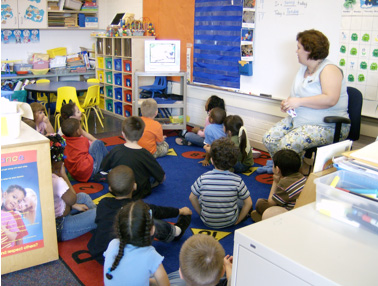
      1. Lesson begins with a "Tuning In" clip that demonstrates a phonological awareness skill or
          letter sound. Other video clips are played that show the vocabulary content for the lesson. The
          teacher and students discuss the video and practice new skills and vocabulary.

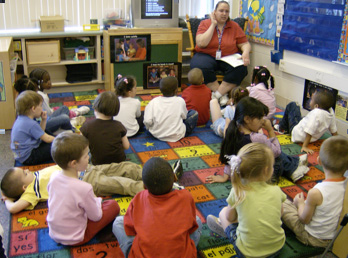
      2. The teacher engages the students in listening and speaking activities that reinforce content. In
          the photo above, the teacher is leading a "call-and-response" exercise.

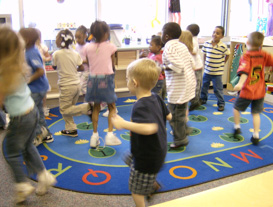
      3. The class transitions to circle time activities that use movement to reinforce content, such as
          jumping during a unit on exercise.

      4. The children are read a book that has been "specially developed for each curriculum category
          to illustrate and review key concepts." They also color take-home books about the concepts.
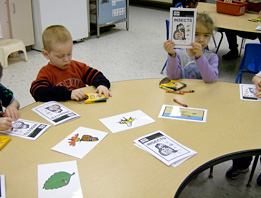
          The WOW website tells us that the children in this photo are looking at picture cards to figure
          out how they should color their take-home books.

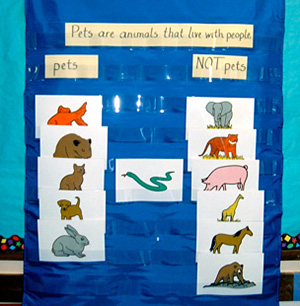
      5. The children use picture cards and pocket charts to sort images that represent the vocabulary
          content learned in a specific unit, such as "pets."

     The second phase of World of Words allows teachers to choose activities and extensions that support the WOW curriculum during centers, free time, or other parts of the day. In a unit about pets...

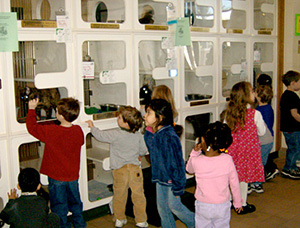
     Some teachers got really imaginative and allowed their students authentic experiences, such as taking a field trip to the humane society...

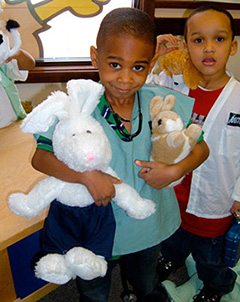
     ...or designing a dramatic play center about veterinary medicine.

 
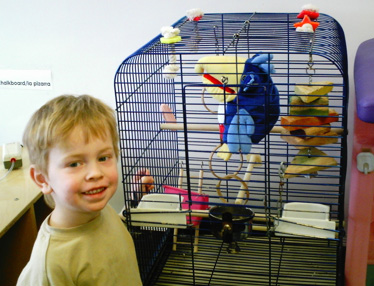
     Others were not so inventive, though this class "pet" was likely very low maintenance.

     There you have it: World of Words, developed with the help of Dr. Susan Neuman. Overall, I have nothing against the idea of introducing preschoolers to new vocabulary. Knowing the names for things can only help with communication, which will later aid in reading, writing, and a host of other subject areas. It also gives children more confidence and a feeling of ownership of the world around them. My main issue with WOW, though, can be summed up in one word: authenticity. I believe that the deepest learning comes from student initiative--a desire on the student's part to satiate curiosity. It seems to me that WOW is a prescribed curriculum in which student interest matters little. Better in my eyes would be a vocabulary-rich environment spurred on by student inquiry. If a group of students is asking questions and showing interest in animals and pets, then by all means present content-specific vocabulary about that topic. If a bug in the play yard is piquing interest one day, fill them up with the "grown up" words to describe what they are exploring. You don't need picture cards and videos--find them the real thing. Let them hold, smell, and taste a juicy pear. Let them observe a caterpillar that tickles their fingers as it crawls.

Let them be awed and inspired by the world around them. Let them learn the words that describe it. Let the students lead.

Saturday, February 1, 2014

Nurturing Literacy

     Ah, phonemic awareness. I came to know this term, before I ever started a teacher education program, as a substitute teacher working in elementary classrooms. To me and my students, phonemic awareness was a time each day, working in yet another leveled group, that I got out a big, spiral-bound book and led the children through boring, scripted exercises. "I am going to say two sounds," I would read. "You say the sounds back to me, then put them together to make a word. Are you ready, Daniel? f - ish. Now you say it back to me." Despite the enthusiasm I attempted to bring to the exercises, the kids would look back at me, nonplussed. "I don't like this game," they would say.

     Honestly, at that time, I couldn't blame them. The activities were boring and repetitive. I hated reading the script. The kids hated parroting back to me, and hated even more when they struggled in front of their peers. I felt like phonemic awareness was another drill-and-kill system designed more with bubbles in mind than a child's brain--no imagination, no play, no humor.

      Imagine my happy surprise upon reading Chapter Four of Rasinski and Padak's From Phonics to Fluency. In this chapter on phonemic awareness, the authors assert that, "for most students, phonemic awareness is nurtured more than it is taught." Examples of activities to nurture phonemic awareness in students include rhymes, chants, songs, poetry, nursery rhymes, jump rope chants, tongue twisters, popular lyrics, and raps. How refreshing and reassuring to know that, for the general student body, scripted phonemic awareness exercises do not make the list.

     There is something this fabulous list reminds me of: Waldorf Education.

     Literacy instruction in Waldorf Education tends to get a bad rap from those who don't take the time to understand it, mainly because formalized instruction in reading and writing do not begin until first grade in a Waldorf School. However, this does not mean that kindergarten is an unproductive time for literacy learning! Like Rasinski and Padak say in Chapter Four, "kindergarten is a place for children to become ready for school and ready to learn to read." The Waldorf approach does just that.

Circle time in a kindergarten class at the Waldorf School of Louisville
     Waldorf kindergarteners have circle time each day, in which they learn seasonal songs, rhymes, verses, and chants. The children are playing with sounds and language, taking in rhyme, cadence, and emotion, stretching their understanding of phonemic awareness. Waldorf kindergarteners are also told stories from fairy tales and folk tales, like the Three Billy Goats Gruff. These stories have simple plots and repeated elements that the children can grasp onto. It is common for a Waldorf kindergarten teacher to retell the same story several days in a row. The children become very familiar with the language, characters, and plot, and incorporate them into their own play through drama--living out the story again and again.


 The Waldorf kindergarten builds a foundation for the literacy learning that will happen when the children reach first grade, where their familiar characters and stories take on new life in writing. But I think that may be a blog post for another day.

(Want to know more about life in a Waldorf early childhood room? Sneak a peek here.)