Showing posts with label intervention. Show all posts

Sunday, February 16, 2014

World of Words

     I recently listened to a Voice of Literacy podcast featuring Dr. Susan Neuman of the University of  Michigan. In the podcast, Dr. Neuman presents a vocabulary curriculum trial that she has helped develop. Called World of Words (or, WOW), the program is an intervention that aims to extend preschoolers' vocabularies in future content areas such as science and social studies. Dr. Neuman gives an example of the word pear: if preschoolers are taught the contextual relationship between pear, fruit, and healthy, then when they encounter apple or mango, they will be able to draw upon their schema for fruit and better understand the new vocabulary. Dr. Neuman describes this as teaching vocabulary through categories (to me this seems synonymous with themed units), and she emphasizes the importance of this planned vocabulary instruction to achieve better student outcomes. Dr. Neuman also hints at the idea that this will level the playing field between students who are upper- or middle-cass and those who come from lower-class families, where children may not get as much vocabulary enrichment at home.

     I did some further research into the World of Words program, which can be found through their website via the University of Michigan. WOW's program description is as follows:
" The World of Words (WOW) curriculum integrates multiple sources of information and technology to stimulate children's literacy development in content areas aligned with national pre-kindergarten standards. In collaboration with the creators of Sesame Street®, WOW uses child-friendly media to support children's learning as they encounter new words and concepts in science, mathematics, social studies, and health. Throughout the WOW curriculum, teachers guide children through developmentally appropriate exercises to increase literacy skills while developing their knowledge and vocabulary in academic content areas."
      I will confess here that until reading this I was unaware that there are national content standards for preschoolers. I think that you readers are already well aware of my thoughts on academic instruction in early childhood, so let's look more at the WOW curriculum:
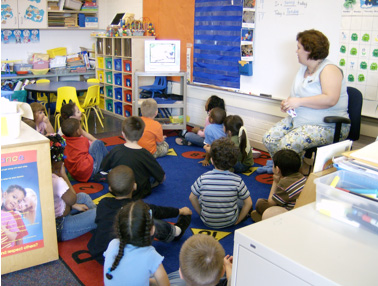

      1. Lesson begins with a "Tuning In" clip that demonstrates a phonological awareness skill or
          letter sound. Other video clips are played that show the vocabulary content for the lesson. The
          teacher and students discuss the video and practice new skills and vocabulary.
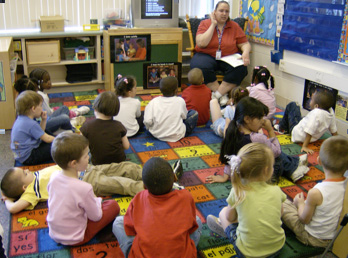
      2. The teacher engages the students in listening and speaking activities that reinforce content. In
          the photo above, the teacher is leading a "call-and-response" exercise.
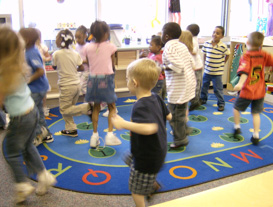
      3. The class transitions to circle time activities that use movement to reinforce content, such as
          jumping during a unit on exercise.

      4. The children are read a book that has been "specially developed for each curriculum category
          to illustrate and review key concepts." They also color take-home books about the concepts.
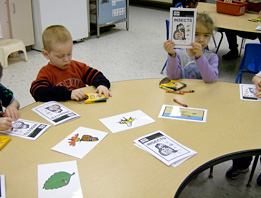
          The WOW website tells us that the children in this photo are looking at picture cards to figure
          out how they should color their take-home books.
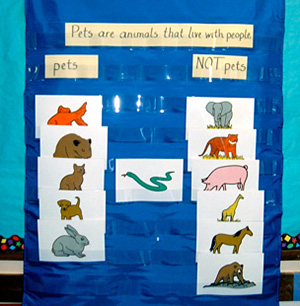
      5. The children use picture cards and pocket charts to sort images that represent the vocabulary
          content learned in a specific unit, such as "pets."

     The second phase of World of Words allows teachers to choose activities and extensions that support the WOW curriculum during centers, free time, or other parts of the day. In a unit about pets...
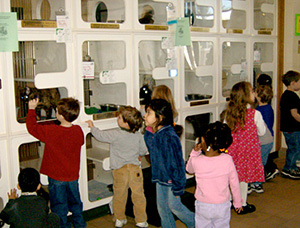
     Some teachers got really imaginative and allowed their students authentic experiences, such as taking a field trip to the humane society...
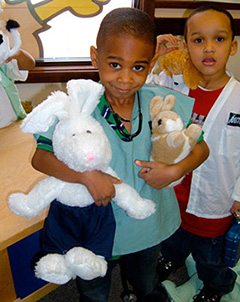
     ...or designing a dramatic play center about veterinary medicine.

 
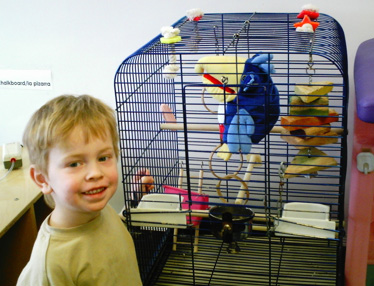
     Others were not so inventive, though this class "pet" was likely very low maintenance.

     There you have it: World of Words, developed with the help of Dr. Susan Neuman. Overall, I have nothing against the idea of introducing preschoolers to new vocabulary. Knowing the names for things can only help with communication, which will later aid in reading, writing, and a host of other subject areas. It also gives children more confidence and a feeling of ownership of the world around them. My main issue with WOW, though, can be summed up in one word: authenticity. I believe that the deepest learning comes from student initiative--a desire on the student's part to satiate curiosity. It seems to me that WOW is a prescribed curriculum in which student interest matters little. Better in my eyes would be a vocabulary-rich environment spurred on by student inquiry. If a group of students is asking questions and showing interest in animals and pets, then by all means present content-specific vocabulary about that topic. If a bug in the play yard is piquing interest one day, fill them up with the "grown up" words to describe what they are exploring. You don't need picture cards and videos--find them the real thing. Let them hold, smell, and taste a juicy pear. Let them observe a caterpillar that tickles their fingers as it crawls.

Let them be awed and inspired by the world around them. Let them learn the words that describe it. Let the students lead.

Monday, January 27, 2014

Ready or Not?

     Let me preface today's blog post by saying that I absolutely acknowledge the importance of reading and writing, for both children and adults. I believe that reading has the ability to inform us, transport us, and empower us. I am an avid reader, and in my ideal universe, everyone else would experience the love I have for literature. As a future teacher, I will do whatever I can to help my students achieve that--and I know that some students will need extra support.

     Catching Readers Before They Fall by Pat Johnson and Katie Keier does an excellent job of providing ideas and insight for early childhood and elementary teachers in the trenches, trying valiantly to ensure that all students are successful readers. It's an incredibly informative book--I highly recommend it.

     There's just one point that I am unclear about: who are the struggling readers and how do we identify them? Where is the fine line drawn between a child labeled a "hardest-to-teach" student, and a child who is not yet ready for formal reading instruction? Catching Readers appears to take the stance that all children are ready for instruction. In their chapter about Vygotskian theory, a distinction is made between Piaget's belief in stages of child development and Vygotsky's idea that what a child can't learn alone, he can learn from an experienced other. Catching Readers uses David Wood's 1998 study of mothers teaching their toddlers complex puzzle construction to illustrate Vygotsky's theory. While the three-year-olds couldn't assemble the block pyramid independently (in fact, the study says that this activity could not be performed by children under seven), they could complete the puzzle with support from attentive mothers.

     Can this example be applied to reading instruction? Should it be? The children in Wood's study would eventually be able to assemble the puzzles when they reach the developmentally appropriate age for the activity (8+). What benefit do they receive from assembling the puzzle at a much earlier age? Likewise, with the push for reading instruction coming earlier and earlier (see: Your Baby Can Read), how do our children benefit from literacy instruction at age three--or younger? Conversely, is it really so detrimental to them if formal reading instruction is introduced in kindergarten or first grade?


     In the case of early childhood, are we catching readers before they fall? Or are we catching readers before they're ready? When are struggling readers simply reflecting expectations that are out of touch with developmental appropriateness?